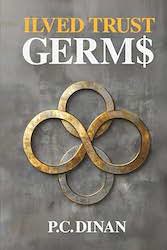
When a vast philanthropic organisation wages war on poverty and disease, should it be trusted without question—when its nobility is just a mask?
What if the most dangerous threat to humanity isn't a rogue state or terrorist cell, but a global entity that has perfected the art of hiding its true intentions in plain sight? What if their real goal is something far more sinister, something pulled directly from the pages of a declassified Security document: to control population growth in developing nations to protect their own economic and political supremacy? This is what sparked my debut action-thriller, ILVED TRUST: GERM$.
Research then uncovered a chilling fact: thirteen eminent microbiologists, all with expertise in gene sequencing, were found dead in violent or suspicious circumstances. It was a terrifying statistic on its own, but deeper research suggested a far more insidious consideration still—their combined knowledge could potentially create bioweapons that only affect, or leave untouched, specific racial groups.
For thirty years in the UK television industry, my job in the cutting rooms was to assemble facts into a narrative. But factual programming is bound by the evidence; you can only report what is already known. A thriller has the freedom to step into the gaps, to follow the whispers from redacted documents, and to connect the dots. This is the crucial difference between a story ‘based on’ real events and one ‘inspired by’ them. While the former must stand up to legal scrutiny, the latter can take disparate, proven facts and weave them into a speculative narrative that exposes a potential, hidden truth.
My research for Ilved Trust wasn't about inventing a nebulous conspiracy; it was about joining the dots of information already in the public domain and presenting a stark new picture seen through a transparent frame.
What began as a thread of curiosity became a complex web of convergence. Seemingly unconnected areas—declassified government policy, historical medical scandals, and chilling manifestos like the Georgia Guidestones—started to align. What if these weren't random facts, but the individual components of a much larger, hidden architecture? And once that structure is revealed, the hidden truth within it—terrifying and seemingly undeniable— is a cage constructed by the greed of a ruthless corporatocracy.
As an editor, I have honed my instinct for looking at the same story from multiple sources—to identify what is being emphasised and what is being omitted. In a way, that's what I'm inviting the reader to do within the world of the novel: to read between the lines, to determine the fact within the fiction that such a nefarious elite would brazenly peddle.
Of course, the moment you begin to question their narrative, you risk being labelled a 'conspiracy theorist'—a term often weaponised to dismiss and undermine inquisitive people. This is where fiction becomes so powerful. An intelligent thriller can bypass that label. It can wrap a powerful moral question inside a gripping mystery, allowing the reader to explore a challenging idea without fear of ridicule. I’ve always been drawn to stories that do this, like Michael Mann’s film The Insider, based on Marie Brenner's journalism, or John le Carré’s masterful novel, The Constant Gardener. These are stories about ordinary people who discover a terrible truth and are forced to risk everything to expose it.
Their conviction and resolve in confronting corrupt systems and the emotional cost to themselves is beyond inspiring, it’s galvanising. Throughout the many years of researching my novel—piecing together disparate facts, falling down rabbit holes, and uncovering unsettling truths, I felt aligned to a character in a thriller. That is the exhilarating, unsettling, dangerous journey of discovery I want to take the reader on with this book.
That's precisely why the hero of Ilved Trust, Joe Porter, is a world-class sailor, not a lawyer or a spy. He's an everyman who, like the reader, has no preordained answers. His expertise is in reading the wind and tides, not intelligence reports. When his search for the truth behind his sister’s murder plunges him into this shadow world, we see this terrifying reality through his eyes, learning the rules of the game as he does, one dangerous step at a time.
The enduring power of the David and Goliath archetype speaks to a fundamental human hope—that one person, armed with courage and the truth, can stand against a seemingly insurmountable power.
Porter's greatest weapon is his diverse, international network of allies. A united voice is his best chance to overthrow the establishment. In Ilved Trust, that philosophy is put to the ultimate test. So, am I an activist in the classic sense of the word? No. I do believe, however, in the adage ‘the pen is mightier than the sword,’ not because a book can overthrow a government, but because it can awaken curiosity. A great story can’t change the world, but it can change the reader. My goal isn't to provide answers, but to craft a story that stays in the mind long after the final page is turned—to arm the reader with the most powerful tool of all: the right questions. In an age of disinformation, a population that starts asking, 'Who is telling this story, and why should we believe them?' is where a quiet rebellion begins.
You can find out more about Paula Dinan at her website www.pcdinan.com
Her debut thriller, ILVED TRUST: GERM$ is available to buy in hardcover, paperback and eBook from Amazon https://amzn.eu/d/6iHcQuY