Yet another mash-up of musings on crime fiction ancient and modern. Think of it partly as the ramblings of someone who has read more thrillers than he needed to, some so you don’t have to, and some you should look forward to.
Scorcher!
Braving Central London temperatures of 34°C (93°F in old money) it was a pleasure to attend the lavish summer garden party thrown by Jasper Joffe, where the staff of Joffe Books mingled harmoniously with the staff of recently-acquired Severn House. It was a delight to gossip with fellow authors Simon Brett, David Hewson and Dolores Gordon-Smith and to rendezvous with the Shots team of Mike Stotter and the voluptuous Ayo Onatade.
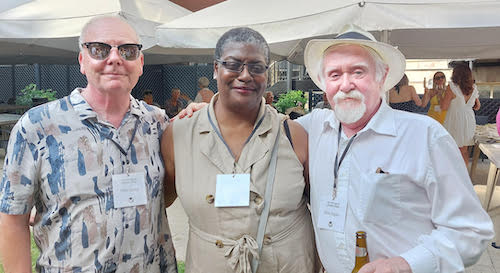
Readers of delicate disposition who have an interest in things sartorial will no doubt be horrified by this image, not because Mr Stotter thought that shorts were appropriate for the occasion but, to my endless embarrassment, I was, for the first time in living memory, photographed in the capital not wearing a tie.
We meet at last
Some fourteen years after I reviewed (and enjoyed) the historical thriller Fear Itself I managed to meet the author, Andrew Rosenheim, at the launch of his new novel, The Interpreter’s Secret [No Exit]. The interpreter in question is an innocent (naïve?) American who overhears and record something he shouldn’t at an unofficial sidebar meeting at a G20 Summit in Stockholm. The problem is he doesn’t understand what it is he’s overheard and why Russians and Americans are keen to get hold of him.
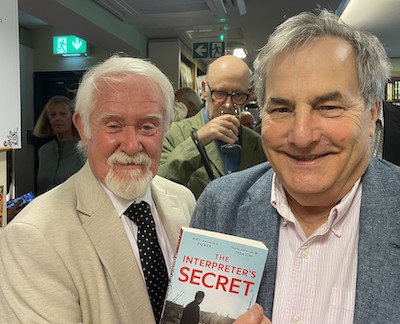
Our hero, Thomas Weaver, is a keen trout fisherman (there are lots of references to fishing) and as he goes on the run in London, you can’t help but think he is the fly being dangled to attract the bigger fish. He is aided by an enigmatic female, who displays a suspicious knowledge of spy tradecraft, on his escapades which include escaping from an ambush on an e-scooter – oh, the joys of contemporary London…
Apart from congratulating Andrew on his new book, I took the opportunity to ask his advice on a subject I was researching, the pro-Nazi German-American Bund which featured in his Fear Itself thriller. Without hesitation, Andrew recommended the new novel by Scot Alan Parks, Deception, just published by Baskerville and which, as it happens, was the next book on my bedside table.
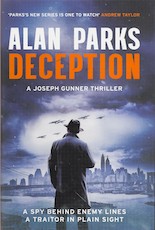
Alan Parks made an initial impression with an outstanding series of ‘Tartan Noir’ thrillers set in Glasgow, but last year introduced a new series hero, Joseph Gunner, a former policeman, wounded at Dunkirk, but dragged back into service as a copper in wartime Glasgow. Deception sees Gunner seconded to a secret British dirty tricks operation in New York (which includes a rather irritating naval officer called Fleming) aimed at bringing America into the war. The time frame of the book is the first week of December 1941, so we know what’s coming if Gunner doesn’t and he struggles with his own conscience as he sets up ‘honey trap’ stings of prominent American political figures who might be pro-Nazi. He has few qualms, though, about continuing his personal crusade against the British class system.
Deception is a fast-moving, well-researched hybrid of detective story (the detective being very much a stranger in a strange land) and historical spy thriller with well-drawn characters. It works on all levels and I will be amazed if it does not feature on multiple awards’ shortlists this year.
From the To-Be-Read Pile
I don’t know why it has taken me so long to get round to Joseph Kanon’s 2024 novel Shanghai as I have read most of his fiction with great pleasure and this one does not disappoint.
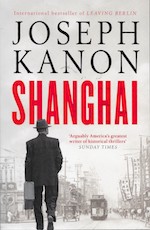
Set in 1939-41, with a tremendous scene-setting section as persecuted Jews flee Nazi Germany by boat from Trieste, most of the action takes place in a lawless Shanghai threatened by the invading Japanese, which may not sound like a safe haven, but at least it’s not Berlin. One of the refugees, Daniel Lohr, is involved in some shady dealings from the off and on the voyage east is instantly attracted to a female passenger but also comes to the attention of a Major Yamada of the Kempetai, the Japanese Gestapo. Once in Shanghai, Daniel finds himself the reluctant heir to a casino and in the middle of a turf war between Chinese gangsters. There are many familiar Kanon themes: the star-crossed lovers who have to escape a city or a country, the corruption of virtually every figure in a position of power, unexpected and shocking acts of violence, political motives and loyalties betrayed. And there is a splendid additional twist as Daniel’s political convictions back in Berlin are slowly revealed.
Missions Only Just Possible
I don’t know why but the warm weather has brought on an attack of the Quillers as I am gorging on the adventures of super-spy Quiller, as created by Adam Hall, one of the pen-names of Elleston Trevor (1920-1995), which itself was originally a pen-name of Trevor Dudley-Smith. [He liked the Elleston Trevor name so much he legally changed his name to it.]
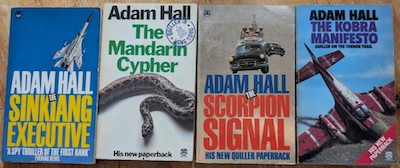
To my surprise and great delight, I find there were Quillers I had not read before, including The Sinkiang Executive from 1978 where Quiller gets to fly a Russian jet fighter into Asia on a one-way trip. Once on the ground and alone (as usual) in enemy territory, Quiller literally throws himself under bus to escape his pursuers. Tense, taught and fast-paced, this mission gives readers a brief glimpse of Quiller’s cynical sense of humour and his sexual prowess – but don’t worry, it doesn’t slow down the action. Apart from changes in political geography over the last fifty years, the book holds up remarkable well.
Sampling Simenon
I have been inundated with yet another email from a reader (that makes four) who claims, like me, to enjoy the short novels of Georges Simenon as ‘palate cleansers’ between other books they could or should be reading. I have just finished the excellent Letter To My Judge which was first published in 1947 but is now available in English thanks to a sumptuous edition by Penguin Classics and is one of the best crime novels I have read this year so far – genuinely hypnotic.
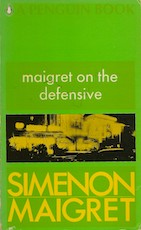
I already have my next refresher lined up. This time it’s an Inspector Maigret – actually Superintendent Maigret by now – from 1964, Maigret On The Defensive, but I will try and pace myself.
Tinker, Tailor, Soldier, Nudist
I am always on the look-out for books and authors which escaped entry in my reader’s history Kiss Kiss Bang Bang, covering the golden age of British thrillers (1953 to 1975), and seem to have no trouble finding them.
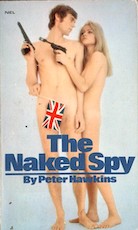
I cheerfully admit that I had neither read, nor heard of, either The Naked Spy (1974) or its author Peter Hawkins until recently. The novel, a New English Library paperback original, is the story of a disgraced British spy hiding out in a nudist camp in the south of France – and that’s all I know about it, resisting the temptation to speculate on whether the spy in question misunderstood the instruction to ‘go undercover.’
The little I know about Peter Hawkins was gleaned from Steve Holland’s invaluable website Bear Alley. Born in London in 1924, Hawkins was a journalist, known in the 1950s for long-running exposés of Satanism, who moved to the south of France and between 1969 and 1975 turned out a handful of paperback originals suggestive of the salacious goings-on in the world of show biz.
For some unknown reason The Naked Spy never achieved the success of Tinker, Tailor, Soldier, Spy which came out in the same year.
Una lettura rilassante
I am delighted to hear that Sergio Angelini, the creator of that invaluable podcast Tipping My Fedora, is enjoying a good book whilst relaxing next to a swimming pool in a villa in Umbria.
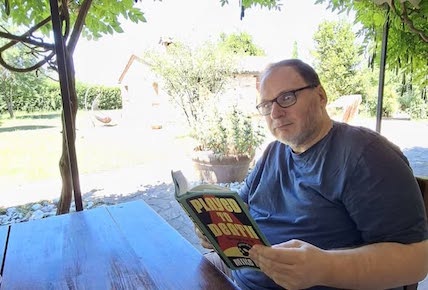
Not that I am in any way envious, for there can be little else to do in football-free Italy just at the moment.
New MacDonald
I have long been a fan of one of the kings of the Golden Age, Philip MacDonald (1899?-1980) and have a fair collection of his fiction, though he was also a prolific film scriptwriter after moving to America in 1931. It was only the other day when the 1943 morale-boosting war film Sahara was shown on television, that I learned that he wrote that one (and not, fortunately, the 2005 film of the same name based on a book by Clive Cussler.)
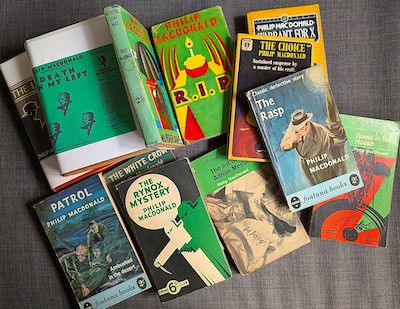
Many years ago, I wrote an appreciation of MacDonald’s series detective, Colonel Anthony Gethryn, for an anthology edited by Maxim Jakubowski and then an Introduction to the 1992 Black Dagger reissue of probably his most famous novel, The List of Adrian Messenger, which was filmed by John Huston with an all-star cast. So, all-in-all, I thought I was well-versed in MacDonald’s output.
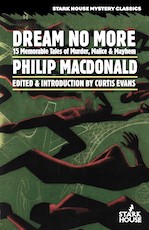
Those never-say-die publishers at Stark House Press in America have, once again, surprised me by publishing, for the first time I believe, a collection of 15 of his short stories under the title Dream No More, none of which I have read. I am looking forward to continuing my education.
Homework
Throughout the summer I have set myself a homework project to improve my knowledge and appreciation of that shimmering city Venice, in advance of attending the wonderful Venice Noir festival of crime writing in November. Not that I will be there in any capacity other than as a fan of both the genre and the city. I am more than happy to leave centre stage to international writers far above my pay grade and be able to relax in the audience in one of the staggeringly beautiful and historic locations or simply lurk in one of the multitude of cool bars and restaurants on offer. My only regret when there is that none of my thirty-six books have been translated into Italian, but I do not dwell on that too much as there are many distractions in Venice.
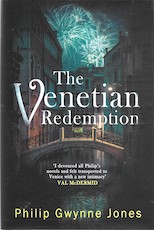
But I am preparing for any eventuality by reading anything I have not read before, in which Venice is a key character, starting with The Venetian Redemption by Philip Gwynne Jones [Constable, out now]. Philip is a Welshman lucky enough not to live in Wales, but Venice, and is a charming author of delightfully cosy mysteries set in Italy. The Venetian Redemption is set around one of the city’s spectacular religious/civic celebrations the attempted poisoning of the British honorary consul Nathan Sutherland, who always does what his cat tells him to, though he really should listen more to his wife. It is a wonderfully atmospheric story, ripe with the sights and smells of La Serenissima but I will have to have words with the author as the map provided in the book identifies the location of my second-favourite restaurant in Venice on the ‘street of the assassins.’ (Where for some reason, the staff always call me Michelangelo.)
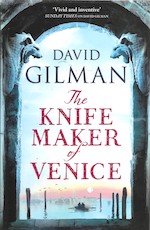
For a taste of Venetian history, I will delve back into the early seventeenth century with The Knife Maker of Venice by David Gilman [Head of Zeus in August]. I have read and enjoyed David Gilman’s contemporary action thrillers but have not until now tried one of his historical novels, which form the bulk of his output. I look forward to the learning experience.
One thing I did learn, many decades ago when at school, was that the ‘Italian Wars’ of the late fifteenth and early sixteenth centuries, were almost impossible to understand. In an early chapter in The First Ghetto: Venice and the Jews [Picador], historian Andrew Lee takes a brave stab at explaining who was fighting who, where and, occasionally, why but I remain bemused and can only think of Harry Lime’s iconic summation in The Third Man about the Renaissance, Michaelangelo, Switzerland and cuckoo clocks. Ironically, many Swiss were not carving cuckoo clocks but fighting as mercenaries in the Italian Wars. That aside, The First Ghetto is superlative history of Venice and the political and economic roles of its Jewish population, which was often resented but always needed.

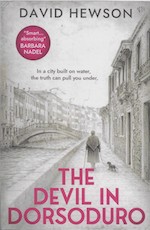
And I cannot possibly prepare for Venice Noir without reading the new novel by David Hewson, one of the British leading lights behind the festival, The Devil in Dorsoduro [Bloodhound Books]. Having survived the alarums and excursions of last year’s The Four Deadly Seasons, retired archivist Arnold Clover is drawn into the investigation of an elderly Englishwoman in Dorsoduro, one of the six historic regions, or sestieri, of Venice and the one built on solid ground rather than over water. Clover is an engaging, if reluctant, hero and a charming guide to all things Venetian thanks to David Hewson’s encyclopaedic knowledge of, and clear affection for, the city.
As a sidebar and not sparing his blushes (though he knows this will cost him in aperitivi), David’s earlier novels set in Rome and featuring his detective Nic Costa have just been made available in a ‘box set’ of e-Books by Joffe Books. They come highly recommended, especially The Villa of Mysteries, by this long-time fan.
The Spice Road to Essex
Jumping to near the top of my tottering To-Be-Read pile is The Saffron Thief by T.L. Mogford, which is published later this month by HarperCollins. An historical thriller set in 1666 at the heart of which is the incredibly lucrative trade in saffron as grown around the famous town of Saffron Walden (the clue is in the name) out here in the Eastern Marches.
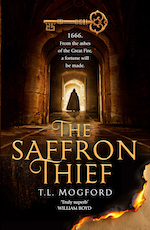
I am also curious to see how the career of T.L. Mogford has progressed since he went ‘legit’ and started writing imaginative and beautifully-researched historical novels. You see, I remember him when he was merely Tom Mogford and the author of a series of exceedingly good private eye novels set on various islands in the Mediterranean. It was as Tom that he made his debut at CrimeFest as part of a team in one of my I’m Sorry I Haven’t A Cluedo pantomimes along with (Sir) Ian Rankin and Andrew Taylor.
The Bomber Returns
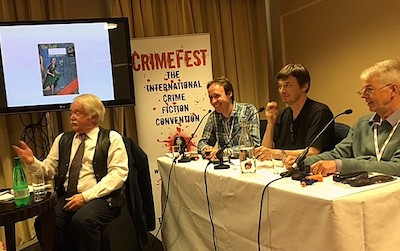
Any mention of the much-missed CrimeFest conventions in Bristol remind me of the many occasions when I posed for a photograph with either a fellow writer or (more rarely an adoring fan) only to find another familiar face in the frame, having been ‘photobombed’ by that dedicated fan of crime fiction, Timea Cassera,
Seen here with myself and Cathy Ace.
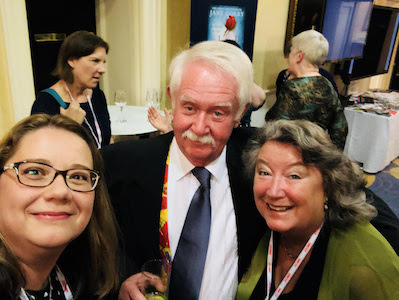
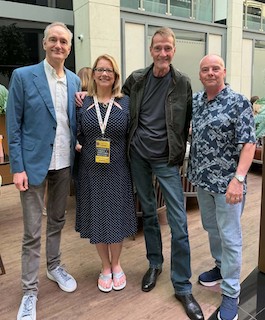
I mentioned this in passing while messaging Shots editor Mike Stotter who was, at the time, at a crime convention I was blissfully unaware of in London. Mike said he remembered the agreeably enthusiastic Timea very well but at that very moment, was deep in discussion with the ‘Reacher Twins’ – Andrew and Lee Child. He even offered to send me photographic proof and when he did so, I was not at all surprised to find an additional familiar face.
Now go and cool off.
Spritzers all round!
The Ripster