A regularly irregular column of musings on (mostly) crime and thriller fiction both ancient and modern. Think of it partly as the ramblings of someone who has read more thrillers than he needed to and some so you don’t have to, and partly as a warning from history.
New Stuff
Although I have not even seen a copy yet, I am looking forward to the new Felix Francis thriller The Chase which is published by Zaffre at the end of this month. To celebrate the event, Felix will be continuing the Francis family tradition of a lavish launch party in the stylish parts of the West End of London. It was always seen as the start of the crime writing social season.
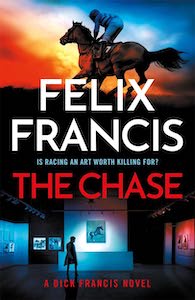
The tradition, started by Felix’s father Dick, goes back to at least 1992, when I was first invited, and I think I have attended all bar one when I was unavoidably detained at my wine merchant’s in Italy.
Out now from Allison & Busby is One Berlin Day by Chris Humphreys (perhaps better known as historical novelist C.C. Humphreys), which is a sort of follow up to his most enjoyable One London Day and although not essential, reading the London volume first is advised.
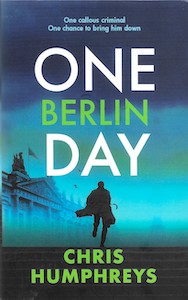
It’s a frantic, almost breathless, tale of British spies going rogue in Berlin on the trail of a people-smuggling kingpin aided and abetted, or maybe hindered, by a touring mob of football hooligans (poor old West Ham getting the blame again) not there for the football but for a gladiatorial punch-up with their German counterparts.
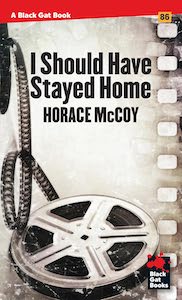
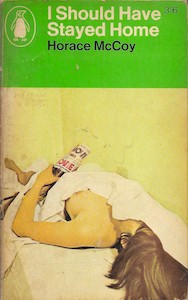
It is a long time since I read anything by Horace McCoy and my Penguin edition of his I Should Have Stayed Home is sixty years old this year, but this month Stark House Press are publishing a new edition in their Black Gat imprint of classic hardboiled noir and hopefully new readers will discover McCoy (1897-1955). The author of They Shoot Horses, Don’t They? should need no further recommendation from me. His relatively small output of dark thrillers are all sharp, pack a surprising punch and have aged remarkably well considering they are all older than I am.
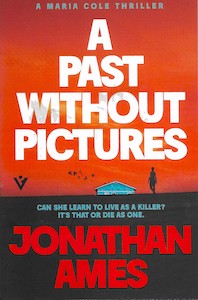
Coming in October as a Pushkin Vertigo paperback original is A Past Without Pictures by Jonathan Ames, a crime novel I (honestly) read at a sitting, which at my age is no mean feat.
It is the tale of troubled (in very many ways) LAPD cop Maria Cole who travels to Alabama to deal with the fallout from her estranged father’s death, which of course she begins to investigate, not trusting the local constabulary. [Spoiler alert: there is a twist in the plot which has been used by Conan Doyle and Margery Allingham, but Ames puts a modern shine on it.] This is a taut, sparse thriller with no unnecessary padding, exploring extremely troubled as well as criminal minds. It ought to be worth a ‘five stars and would recommend’ rating but I can only manage four-and-a-half stars because of one particular phrase. In the middle of a vicious gunfight, one of the bad guys attacks Maria and the author cannot for some reason resist writing: She had killed both his sons! He was enraged. Well, yeah, I’d got that; there was no need to hammer it home with an exclamation mark. With that caveat, I would still recommend it!
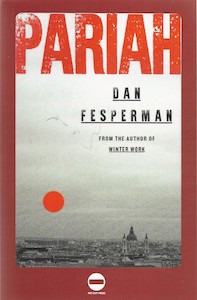
Mere mortals will have to wait until Bonfire Night in November to get their hands on Pariah by one of the American masters of the modern spy story, Dan Fesperman [No Exit Press]. With Pariah, Fesperman is in playful mood, creating a situation which may remind British readers of the Albanian obsession with the comedian Norman Wisdom.
Hal Knight, a disgraced movie star, comedian and former congressman (where the similarities with Norman Wisdom end), turns out to have a super fan in the form of the despotic leader of ‘a country in Eastern Europe in which the security apparatus was even more unforgiving than social media’. The CIA need to get an agent into the country, preferably into the dictator’s inner circle and Hal Knight is the obvious, if reluctant, candidate. But with an ego as big as Hal’s, it’s an offer he can’t refuse and the resulting saga is a whip-smart satire on politics, spies and spying. Highly enjoyable, as are all Fesperman’s novels.
Old Stuff
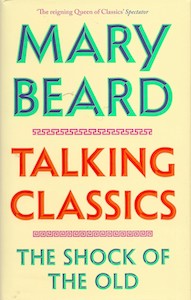
Professor Mary Beard is seriously in danger of becoming a National Treasure and her latest book Talking Classics [Profile Books] is a short, sharp manifesto on why one should study the classics these days, the underlying message being: you might actually like them. The professor makes no secret of the fact that she does and her enthusiasm is humorous and infectious.
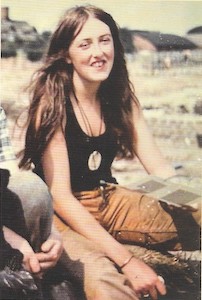
Not only does she provide an author photograph for the jacket which she honestly admits was taken ‘a while back’ (a lesson a few crime writers I can think of should follow) but among the many illustrations, she cites the grate (sic) Nigel Molesworth for an explanation of the gerund.
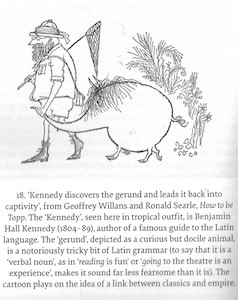
When it comes to quoting classics such as How To Be Topp, Mary Beard certainly knows of what she speaks but I have to admit that my current pin-up in the Classics with a capital C department is Natalie Haynes, whose radio 4 series Stand Up for the Classics is wonderfully informative and brilliantly funny. (And she does a superb impersonation of Liz Truss too!)
From Middle Earth
Actually, the event is really called From A Land Down Under but I couldn’t resist as it involves three New Zealanders, although two of them now live in Australia, and I only hope someone asks them “Why?”.

They will have the chance on the afternoon of 23rd September when Josh Pomare and Rob McDonald talk about their crime fiction in a free open event chaired by ‘Kiwi’ Craig Sisterson, the founder of the Ngaio Marsh Awards for New Zealand crime writing for which, back in 2010, I was one of the initial judges.
If you can find it in the Hogwarts-inspired, book-lined labyrinth that is the splendid Waterstones book shop at 82 Gower Street in London, it should be a cracking event.
Penny For Them
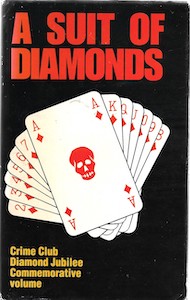
I was introduced to Patricia (‘Penny’) Moyes by the legend that was Sarah Caudwell and it must have been on the publication of A Suit of Diamonds, the anthology celebrating the diamond jubilee of Collins Crime Club in 1990. Certainly, both Sarah and Penny signed my copy of the anthology, in which we all had short stories, and I felt guilty for years after that I had never read one of Patricia Moyes’ well-regarded crime novels featuring her detective hero Chief Inspector Henry Tibbett. Until now.
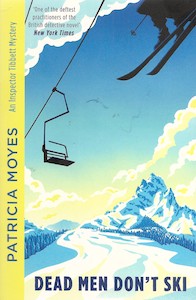
Patricia Moyes (1923-2000) began writing crime fiction while recovering from a skiing accident so it is not surprising that her first novel, and Inspector Tibbett’s debut, was Dead Men Don’t Ski, published in 1959. Eighteen more Tibbett (aided by his wife Emmy) mysteries were to follow and Farrago Books appear to have plans to republish most if not all of them. Four titles are already available, with Falling Star (said by many to be her best) coming in November and Johnny Under Ground in February next year.
I was until recently unaware of the Farrago Books (an imprint of Duckworth) and have discovered they have republished a number of crime novels which I enjoyed in my early association with the genre.
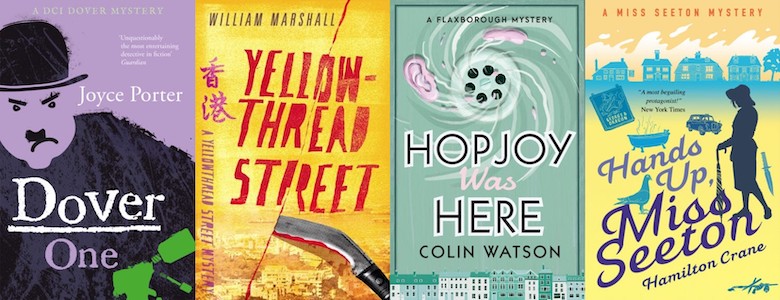
Almost totally forgotten these days, Joyce Porter’s tales featuring the bungling and pretty obnoxious Chief inspector Wilfrid Dover, beginning with Dover One in 1964, were once seen as the template for comic crime fiction. Australian William Marshall burst on the scene in 1975 with Yellowthread Street, the first in a series set in a very seedy police precinct in Hong Kong. Noirish and occasionally surreal, the Yellowthread series were not to everyone’s taste, but they were certainly something different. Colin Watson should need no introduction but sadly probably does. His Hopjoy Was Here, from 1962, is one of the better known of his tongue-in-cheek ‘Flaxborough Chronicles’ – a series well-worth revisiting. And who can forget – certainly not anyone who attended the 1992 Shots-on-the-Page convention in Nottingham where it was launched – the legendary title Hands Up Miss Seeton?
I may have been unaware of the Farrago imprint, but I am familiar with its parent company Duckworth and a review of one of their recent releases prompted me to pre-order a copy of Conversations with an Executioner by Kazimierz Moczarski.
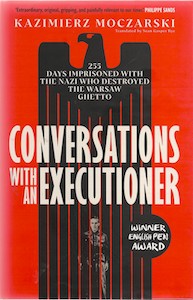
This is a quite extraordinary book. Kazimierz Moczarski (1907-1975) was born in Warsaw and fought with the Polish resistance during WWII, only to be arrested as an ‘enemy of the state’ by the post-war Communist regime. He was imprisoned for eleven years and in 1949, in the cruellest of ironies, found himself sharing a maximum-security cell for more than 250 days with Nazi war criminal Jurgen Stroop, the SS commander who had taken great pride in ‘liquidating’ the Warsaw Ghetto in 1943. Whatever Stroop told his accusers at his various war crimes trials (he was executed in 1952), it was probably not as much as he revealed to his unwilling cell mate and after his release, Moczarski has able to recall those conversations in great detail which, along with considerable research, resulted in Conversations, now published in the UK for the first time. It is a gripping, horrifically fascinating insight into a simple mind twisted by an invidious ideology.
From the To-Be-Read Pile
The last thing I expected when I finally got round to reading Andrew Garve’s 1956 thriller The Megstone Plot was that it would bring back memories of childhood holidays some sixty-five years ago on the magical Northumbrian coast.
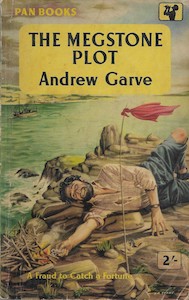
The Megstone of the title is part of the Farne Islands (a rock rather than an island) clearly visible from Budle Bay and Seahouses, both of which feature in the book and both of which were regular venues for my childhood summer holidays. The anti-hero of the book, a heroic wartime submarine commander and a bit of a cad, finds himself in a slightly hush-hush peacetime job at the Admiralty and is bored out of his mind until he begins a torrid affair with a manipulative married woman. Clearly inspired by the wave of spy stories and defections in the 1950s, the lovers cook up a scheme whereby the hero disappears for a week or two, as do sensitive papers from his desk in the Admiralty. The press have a field day, naming him as a defector but when he reappears, they face a major libel action, the proceeds of which will fund a new life for the scheming lovers.
To disappear, our hero borrows a boat and wrecks it on the Megstone rock, stranding himself on a far from ideal desert island without even eight records to keep him company. And although he has planned carefully, things go wrong and his fraud is rumbled by a dedicated, eagle-eyed journalist in a way which is a tad difficult to believe, but as Andrew Garve was the pen-name of veteran journalist Paul Winterton (1908-2001) I think we can allow that.
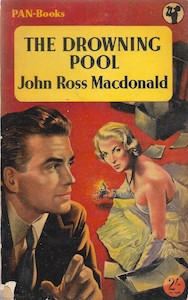
It is years since I read a Ross Macdonald novel, so I have gone back to (almost) the beginning of his famous ‘Lew Archer’ series of California private eye stories. The Drowning Pool was, I think, the second outing for Archer in 1952 and my 1955 Pan paperback still has him listed as John Ross Macdonald, the original pen-name of Kenneth Millar.
The Archer novels made him the logical heir to Raymond Chandler and as Ross Macdonald he was a notable influence on many crime writers, not just American and British. I am remembering why.
Adding to the Pile
I am grateful, yet again, to the unflagging efforts of Charles Beck who regularly updates the website www.denniswheatley.info/whatsnew.asp which is dedicated to the prolific ‘Prince of Thriller Writers’ Dennis Wheatley (1897-1977) who wrote more than 60 books which sold by the million.
The site’s latest updates covers some of the fascinating publicity material which accompanied Wheatley’s books and one, which I own, The Scarlet Imposter (published in January 1940) was promoted as: The first great spy story of the war. The author himself claimed he was rather pleased with the finished product, having written ‘172,000 words in seven weeks’.
But what really caught my eye was a promotional card for Wheatley’s stand-alone 1935 spy story The Eunuch of Stamboul which provides a map of the area which, for a time in the 1930s, was Spy Fiction Central.
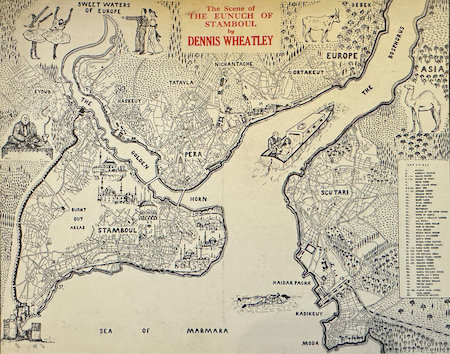
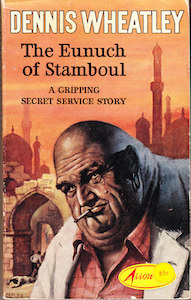
I did not know that The Eunuch of Stamboul had been filmed, in 1936, as The Secret of Stamboul, starring a young James Mason as the amateur spy caught up in international intrigue. I am tempted to track down a copy and add it to my To-Be-Read pile, but only if I can find the 1965 Arrow paperback featuring a most unsavoury character.
The Great Bayeaux Sewing Bee
I am delighted that the hottest ticket in London is to see the Bayeaux Tapestry – as if we haven’t heard enough about people crossing the Channel in small boats.
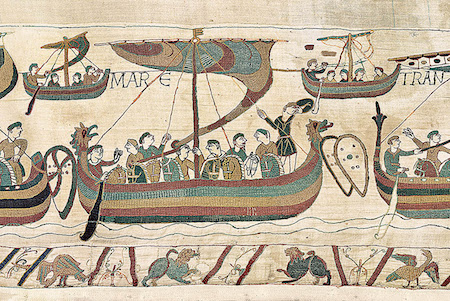
But I do recommend everyone to see it in all its glory, if only to mention (in passing) that I saw it in Caen in Normandy many years ago on a day when I enjoyed an aperitif with Arlette Gondrée in the famous Café Gondrée near the even more famous Pegasus Bridge. I do realise that this gratuitous name-dropping will mean little to younger readers or those who have never seen the all-star war film The Longest Day.
Unboxing
I have become aware that authors these days feel obliged to post pictures and even videos on ‘social media’ which show them opening boxes freshly delivered to their home with the glee of a child on Christmas morning (if children are allowed box cutters these days).
I honestly cannot see what all the fuss is about, but for anyone remotely interested, I can reassure them that my latest consignment of sparkling rosé arrived in perfect condition from my wine merchant in Tuscany.
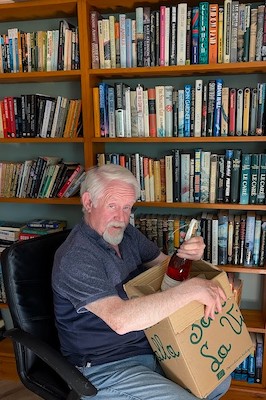
Cin! Cin!
The Ripster