Our Man in Bolrovia
Ian Fleming is said to have always maintained that humour had no place in the spy thriller, but if he did, I think history has proved him wrong, from Len Deighton and John Gardner to Mick Herron and Dan Fesperman, whose new novel Pariah [No Exit Press] shows how spy tradecraft, in the hands of the most unlikely secret agent in the daftest mittel-European country since Ruritania, can be funny, satirical and, at the same time, tense and frightening.
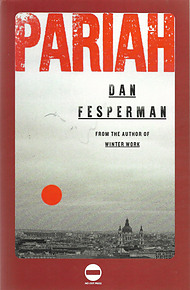
Hal Knight is the pariah of the title as a former comedian, movie star and congressman – three professions he has successfully screwed up thanks to alcohol, misogyny and downright stupidity – and is keeping a very low profile, having been ‘cancelled’ by just about everyone. Everyone, that is, except Nickolai Horvatz, the despotic president of Bolrovia (parallels for which can be found without difficulty in certain east European states), who is the biggest fan of Hal Knight’s comedy and off-colour movies. (Think Norman Wisdom and Albania under Enver Hoaxa.)
When the CIA gets wind that the Bolrovian president intends to invite Knight to the country as an honoured guest, it seems too good an opportunity to pass up to get an agent in place in a country where intelligence is a scarce resource. Thanks to his massive ego, Knight agrees to become a spy after a ridiculously short period of training and his method of reporting his findings back to the CIA falls only just short of the old message-in-a-forked-stick method, even though the ‘intelligence’ he has uncovered is bang up to date.
Part satire, part believable spy story and written by a modern master of the genre, Dan Fesperman’s latest is a corker.
“The name’s Destine; Swithin Destine”
A fictional British spy you’ve never heard of? No, me neither.
In his 1977 guidebook to Who’s Who in Spy Fiction, Donald McCormick wrote: The most prolific period of the spy story was between 1914 and 1939, but it was very far from being the golden age of espionage fiction…Some of the stories were competent, one or two like Maugham’s Ashenden were first class, the vast majority was mediocre and many were appallingly bad.
He was probably right in that overall assessment but he made no specific mention of British spy Swithin Destine as created in 1935 by that ‘Prince of Thriller Writers’ Dennis Wheatley – whose wartime Gregory Sallust adventures are covered in some detail. Perhaps it was because Destine was a one-off creation, standing alone from the prolific Wheatley’s various series featuring the adventures of the Duc de Richelieu and friends, Gregory Sallust, Roger Brook (his Napoleonic era spy) and his famous ‘Back Magic’ novels.
Destine, a British army officer in trouble for assaulting a visiting foreign dignitary (who was behaving very badly), is the hero of The Eunuch of Stamboul and the villain is the titular eunuch, the odious Kazdim Hari Bekar, the chief of the local secret police. Ostensibly, Destine’s mission to Turkey is a genuine gathering of intelligence on the stability of the Turkish government and economy, on behalf of British businesses looking to invest in the country and his cover is as the manager of a cigarette-manufacturing company – where tobacco is described as the golden herb.
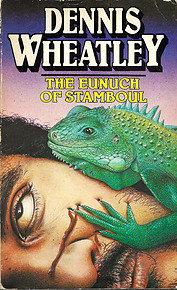
For all Wheatley’s overblown prose and great chunks of historical background (interesting as these are), not to mention descriptions of non-white, non-English foreigners which would give a modern copy editor the vapours, Eunuch is a rollicking spy story, with Destine trying to be the subtle spy whilst clearly out of his comfort zone and distracted by the compulsory romantic entanglements.
The novel was quickly snapped up for filming in 1936 as The Secret of Stamboul, though Swithin was mercifully renamed Larry and was played by an energetic young James Mason. The film was also known as The Spy in White and it was the second spy-fi film from a Wheatley novel following Forbidden Territory in 1934, which might have become better known had it been directed by Alfred Hitchcock, who had offered for the rights, though it did star Alma Reville, better known as Mrs Hitchcock.
The Kanon Canon
I thought I was well-versed in the majestic spy thrillers of Joseph Kanon, from his debut Los Alamos which I reviewed in 1998 to a personal favourite The Accomplice in 2020 and his most recent, Shanghai, but I discovered that I had never read The Good German. Nor have I seen Steven Soderbergh’s film version starring George Clooney and Cate Blanchett; but at least now I have read the book, which is set in 1945 as Berlin is quartered between the victorious Allies at the end of one war and on the cusp of another, colder, one.
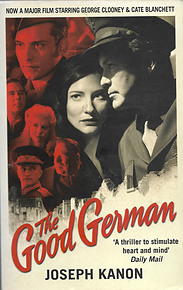
The Good German, which was published in 2001, contains many familiar Kanon tropes: the star-crossed lovers (war-disrupted in this case) desperate to get out of a particular place or situation, a hero determined to do the right thing whatever the cost, an over-hanging threat from the governing powers, numerous innocents (and not-so innocents) caught in the crossfire, and an international canvas of political skullduggery, betrayal and corruption. Life in ruined Berlin is brilliantly done and the over-riding question, with so much guilt permeating the country is: who is ‘the good German’?
Spy Adjacent
Not strictly a spy story, but definitely ‘spy adjacent’ as the saying goes, is the latest adventure featuring Major Boothroyd – ‘Q’ in the world of James Bond –The Man With The Golden Compass [Zaffre] by Vaseem Khan.
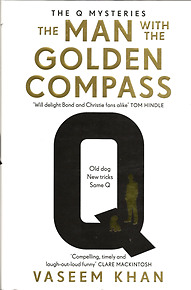
Now retired from MI6, Q cannot avoid getting involved with traditional English murder mysteries, which must make a change, if not a restful one, from dealing with international conspiracies, bizarre applications of modern technology and ungrateful agents who never bring the equipment back in one piece. This is, I think, the second foray into the James Bond franchise by Vaseem, who must surely be the hardest-working crime-writer in the land judging by his frequent public appearances and abundant presence on various social media.
A Reader Writes
I have been somewhat dismissive of the recent fad of ‘unboxing’ where authors pose dramatically with a Stanley knife, or other sharp implement, opening a newly delivered box of books from their publisher and pretending to be viewing the cover for the first time. This activity, almost uniform in execution, is immediately filmed and posted on ‘social meeja’ to the smug satisfaction of the author. I would love it if, just once, an unboxing resulted in the author screaming: Bloody Nora! How drunk were they when they came up with this? {To be fair, Val McDermid posted a wonderful spoof of her unboxing a bulk delivery of toilet rolls.}
I was recently confronted with the problem of ‘unboxsetting’ an ebook boxset of my twelve novels continuing the adventures of Margery Allingham’s famous sleuth Albert Campion [Joffe Books].
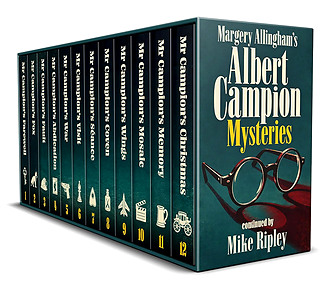
Fortunately, I was not called upon to do anything physical, merely sit back in the glow of them being readily available to anyone with the required technology. To my amazement, within hours of appearing on Amazon, my Campion boxset attracted its first review, from a female ebook reader whose surname was actually Reader…
Sadly, Ms Reader was unimpressed, giving the boxset one star and returning it for a refund with the comment that it was jarring and so unlike anything Marjorie (sic) would write. But it seems that Ms Reader’s reading over the past few months has been disappointing all round. Other one-star reviews dished out by her have included a boxset of novels by John Gardner (sexually explicit) and one by D.E. White (foul language), plus novels by Tess Gerritsen (a Gothic novel gone wrong) and Simon Brett (a real drag).
I take some comfort from the fact that I am in one-star good company (according to one sad reader) alongside writers such as John Gardner, Tess Gerritsen, Daisy White and Simon Brett.
|
Happy New Murder?
I am ringing in the New Year early, having received an advance copy of the first title I have seen to be published in 2027, on 19th January.
The Art of Poison by Katherine Tozer [Firefinch] is a historical mystery based on the very real, and quite sensational in its day, murder trial of twenty-year-old Madeleine Hamilton-Smith in Glasgow in 1855.
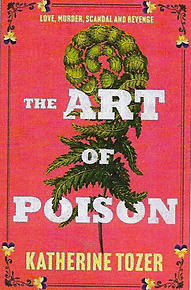
The poison in question is arsenic and the victim a bit of a n’er-do-well Channel Islander who was the much older lover of teenage Madeleine. Unfortunately, young Madeleine had been a prolific letter writer and when her correspondence was read out in court and reported in the press, it shocked Victorian Scotland. There appears to have been little love lost for the murdered Pierre Emile L’Angelier, who really does seem to have been a cad of the first order, and when the jury returned verdicts {spoiler alert} of not guilty and not proven (this being Scotland) on the charges levelled against Madeleine, there was cheering in the streets.
Her case was no nine-day wonder (even if the trial did take nine days), and was the subject a century later of the David Lean film Madeleine, though both Noel Coward in 1950 and now the author Katherine Tozer think David Lean fluffed the ending. Did she do it or not?
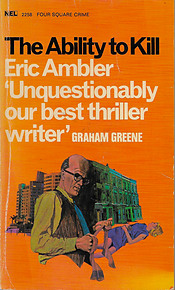
Madeleine’s story surfaced again in one of The Lizzie Borden Memorial Lectures given by Eric Ambler and published in his 1963 collection The Ability To Kill. He describes her as ‘a remarkable woman’ who had ‘always fought back’. After her trial, she married twice and lived until 1928. Latterly in America.
The Fascination of Evil
Thriller maestro Robert Harris, who knows a thing or two about the subject, once said that for readers and writers alike: ‘The Nazis are like a planet with a gravitational pull.’ One of the biggest “stars” in the Nazi galaxy due to his involvement in planning the Holocaust and his dramatic assassination in occupied Prague in 1942, was Reinhard Heydrich, whose presence has been prolific in thriller fiction and screen adaptations.
On film, ‘the man with the iron heart’ was portrayed in Operation Daybreak by Anton Diffring, the British film industry’s go-to casting for sadistic Nazis, ironically a refugee from Nazi Germany because of his Jewish father. Though perhaps the best, icily cold, performance was by Kenneth Branagh in the 2001 TV movie Conspiracy, which featured an equally chilling Stanley Tucci as Adolf Eichmann.
In fiction, Heydrich has figured in dozens of books as the ultimate secret policeman of the Nazi regime, second only to Heinrich Himmler, and at one point in the excellent Bernie Gunther series of novels by the late Philip Kerr, Prague Fatale, Bernie finds himself working for Heydrich. And there was the spectacular, almost mind-blowing, novel HHhH by French author Laurent Binet, which re-told Heydrich’s story around the acronym HHhH which – in German – means ‘Himmler’s brain is called Heydrich’.
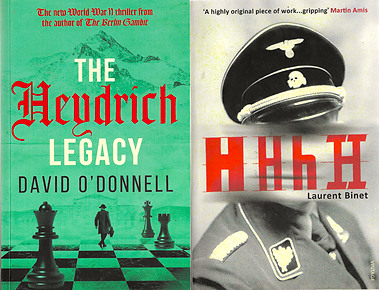
Now comes The Heydrich Legacy by David O’Donnell from Edinburgh publisher Polygon, which is a sequel to his debut thriller The Berlin Gambit, where his fictional hero Rolf Schneider, a police inspector (like Bernie Gunther) was charged by Hitler personally to investigate the assassination of Heydrich. A year on, Schneider and his lover have escaped to Switzerland, but are suspected of having decamped with Heydrich’s secret files – and Heydrich kept files on everybody. Himmler wants those files, as does Joseph Stalin, and so a deadly, two-pronged hunt for Schneider begins and Switzerland doesn’t seem so safe anymore.
I Could Not Resist
I simply could not resist the new cosy crime novel by Craig Melvin from Allison & Busby for two reasons. Firstly because of its quirky title – Mrs Mackerel and the Poisoned Pasty Puzzle - and secondly for the fact that the titular character is a 1950s television cookery presenter clearly inspired by Fanny Craddock.
Now for readers of younger generations, Fanny Craddock, aided by her monocle-wearing husband Johnnie, was the dominant, and domineering, personality of early BBC cookery shows. An established cookery writer, she became known forincreasingly outlandish recipes and a penchant for using food colouring, especially green, to ‘brighten up’ mashed potato.
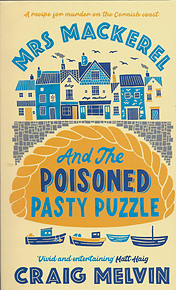
In the book, Mrs Mackerel has decamped to Penzance in Cornwall to get out of the media spotlight and, whilst trying to establish a local bakery, pasties being a speciality as this is Cornwall after all, becomes involved in investigating a local murder. The book jacket describes her as a blend of Miss Marple and Fanny Craddock, which is a pretty scary, but highly entertaining, fusion of ingredients.
More Work for the Undertaker
In a way it’s surprising that more crime novels do not feature undertakers, as they are usually involved (professionally, not personally) at some point in any story involving a successful murder. In her new novel The Mortician, out now from Orion, Sharon Bolton highlights the fact, with her usual icy-fingered precision, that life can be quite murderous for a young female mortician when given the job, with little choice in the matter, of arranging the funeral of a gangland killing. And that is only the start of what turns out to be a bad few days at the funeral parlour.
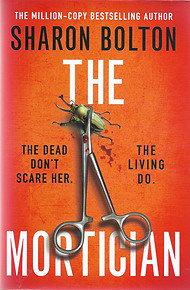
A pacy and gripping crime novel, involving the drugs trade and a brutal home invasion, The Mortician is also notable for being inspired by a true (unsolved) murder case.
Les stripteaseuses
I must admit I am unfamiliar with the work of Scottish-American author Iain Levison, much of whose work seems to have been published first in the US or in France before here. His 2024 novel Strippers Always Need Legal Advice, which will appear here in January from Bitter Lemon Press, was described by Paris Match as using humour like a weapon of mass derision, its target being (mainly) the American justice system.
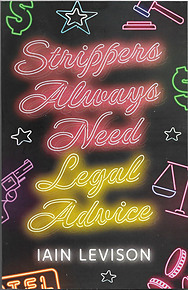
With advance praise like that, plus generous comparisons to the late, great, Elmore Leonard at his deadpan best, I am looking forward to it keenly.
La Serenissima
My next column may be somewhat delayed as I will be reporting on/recovering from the 2026 Venice Noirfestival later this month. As last year, I look forward to sharing an aperitivo with Sir Ian Rankin, who is again, one of the festival’s key speakers.
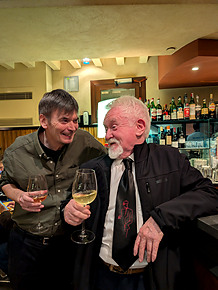
And I am sure there could be time for further aperitiviwith guest speakers Charles Cumming, Denise Mina and Barbara Nadel, not to mention local residents Gregory Dowling, Philip Gwynne Jones and David Hewson.
Cin cin!
Il duca di Ripster
|