I started my thriller, Caller Unknown, at the end. My hero, Ed Constance, has forgotten everything that had happened to him up to that moment. He now finds himself being pursued by a group of assassins whose motivation, but not deadly intention, is a complete mystery to him. He is frightened and alone in a remote wilderness cabin. The one advantage Ed has is that at some stage in his earlier life he recognised this time of mental erasure would come and he seeded clues where he knows his amnesiac self will find them; first to lead him to this cabin and, secondly, to find the weapons that will give him a chance of survival against his unknown foes.
The Hero with Amnesia is not an original premise: the thought processes of characters who wake from a dream into an actual nightmare are fascinating. The Bourne Identity was published forty-five years ago. The hero of The Moonstone (the ‘first, longest, and the best of modern English detective novels,’ T S Eliot), Franklin Blake, loses his memory in a narcotic trance not too dissimilar to the one in which Wilkie Collins apparently wrote his masterpiece. Loss of memory is the key to the mystery.
My own fascination with the subject began with Oliver Sack’s’ brilliant and bestselling memoir of his career as a neurologist, The Man Who Mistook His Wife for a Hat. Sacks’s stories are sad and beautiful. In them, triggers can unearth memories that have been locked away for entire lives. Forgotten songs last heard as an infant suddenly issue word perfect from a nonagenarian’s lips. These anomalies are well known in neurological circles, and are a brilliant device in mysteries. Mr. Memory will spew the secret of the 39 Steps given the right trigger.
Detective fiction is all about revealing what is hidden. Instead of a detective character searching for the truth through clues and witnesses, the reader is, like my central character, groping for memories to unlock the mystery. The amnesiac hero can also be very edgy: in Bourne and in The Moonstone we ask ourselves: what if the protagonist is not actually the hero but the villain of the piece?
Recent thrillers have reflected our society’s real obsession with repressed memories. As we grapple for truth in the post-truth society, what is real? Have we forgotten so much that the truth of our past is almost impossible to recover?
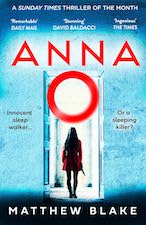
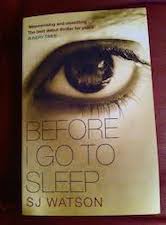
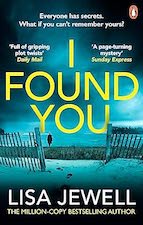
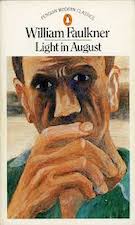
We hear every day of false memory syndrome, dissociative identity disorder, psychogenic amnesia, repressed memories… Fiction reflects society and crime fiction is no exception. Dissociative states in which memory is recovered are a writer’s meat and drink. Often, it’s the psychotherapist who plays detective, but sometimes the psychotherapist has their own psychological struggles. Matthew Blakes’ Anna O with its homage to Hitchcock’s Spellbound and the little-known deep sleep state know as ‘Resignation Syndrome’ has just such a hero. Recently we have had S J Watson’s Before I Go To Sleep with the amazing plot device of a heroine who loses her memory every time she goes to sleep; Lisa Jewell’s first psychological thriller I Found You (a character in a fugue state who can’t remember anyone or anything could turn out to be anyone), other characters struggling with dissociative states spring to mind: Joe Christmas in Light in August is a classic example; Rachel Watson in The Girl on the Train; Alicia Berenson in The Silent Patient) and Charles Harris’s amnesiac policeman in Room 15.
In Caller Unknown, my hero, Ed Constance, has repressed memories embedded in him by the sinister organization that kidnapped him as a child. When triggered he is to be a robot agent in a war against the American state; a kind of modern-day Manchurian Candidate. But his awakening comes too early-- he realizes he is to be a pawn in a bigger game and goes on the run.
The mind is a war zone. Our movies, TV shows and books are full of brainwashing and mind coercion plots. The theme is present, of course with the Nazis and in the Cold War. Later, we have Stockholm Syndrome (Patty Hearst), cult indoctrination (the Manson Family), the CIA and the MKUltra project, with its LSD and hypnosis experiments; the Sodium Amytal test, a procedure that freezes the controlling portion of our brain and unlocks experiences that we have forgotten long before; date rape drugs like Rohypnol and Scopolamine – all of these are real enough...
Recovered memory and identity are the themes of Caller Unknown. I once spent an evening with the great Beat poet Alan Ginsberg discussing the CIA mind control experiments of the 60s and 70s in a haze not dissimilar to Franklin Blake’s. Maybe it was then I became interested in a plot in which the state takes control of its citizen’s minds; maybe that was when the acorn of my book was born.
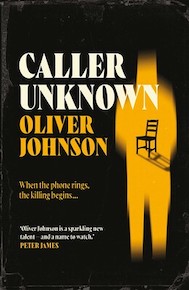
Caller Unknown by Oliver Johnson is published by Point Blank on 22 January 2026, paperback £9.99
Read SHOTS' Review by Michael Jecks